
Sebastão Salgado - Paris
Why I Only Show You What I See

To talk about the Sebastão Salgado exhibition in Paris, I’ve decided to take a slightly different approach than usual.
Lately, I’ve been thinking a lot about how we consume art through our screens. We are often presented with "perfect" digital mockups or AI-enhanced previews of exhibitions: clean, symmetrical, but ultimately disconnected from the world.
Although I am myself an occasional user of digital creation and enhancement, every exhibition I recount, and every image I share, is born from a lived experience. These are my own photos, taken on the ground, with its imperfections, and the touch and feel of the moment.
If I want to be your "gallerist" in this digital space, I owe you the physical truth. So, here is the Sebastião Salgado tribute as I experienced it: no mockups, just the reality of the paper and the walls.
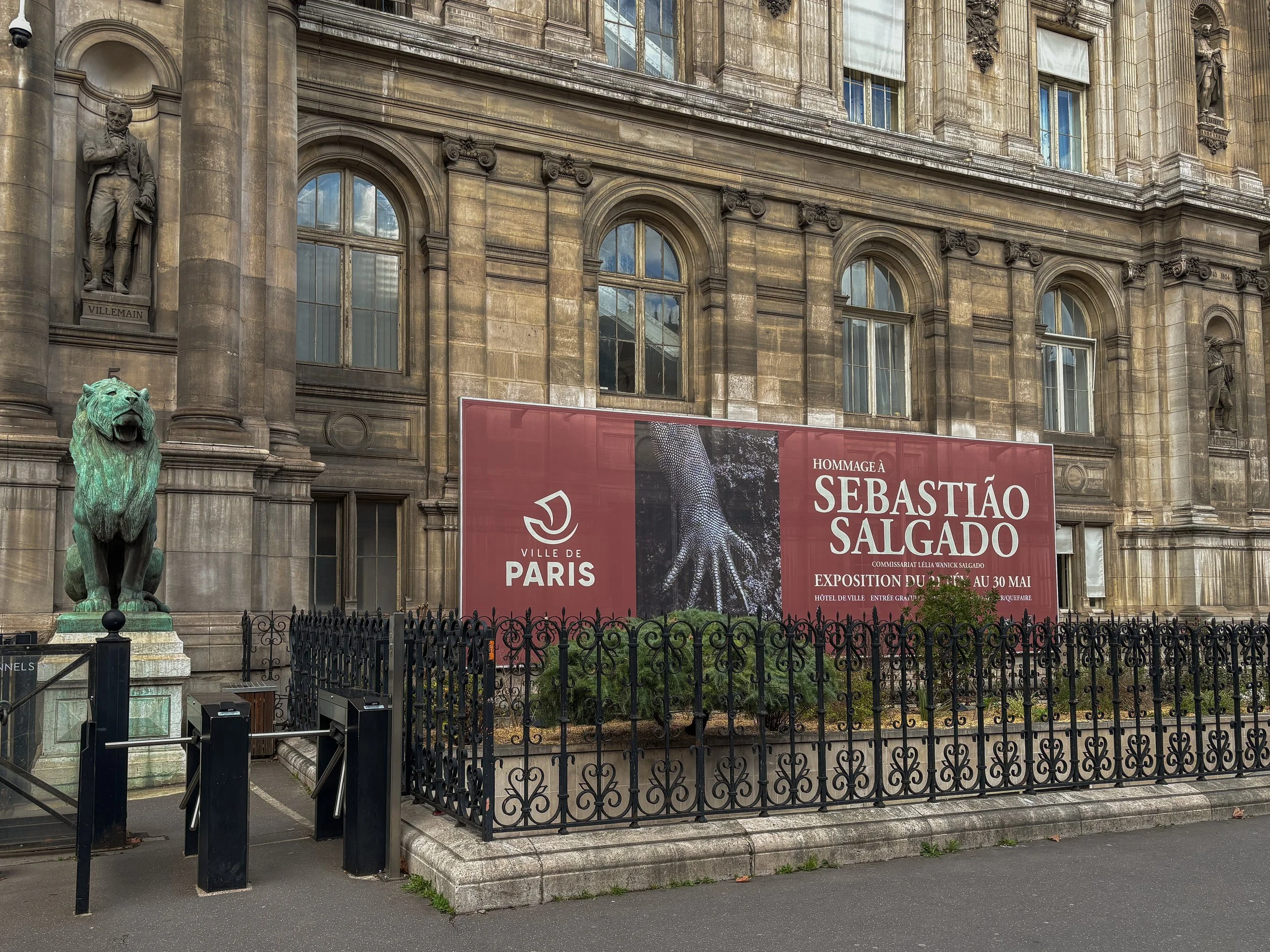
Sebastão Salgado exhibition, entrance
Outdoor, a Visual Appetizer
The journey begins before you even reach the doors. The entrance to the exhibition is tucked away at the back of the Hôtel de Ville, and as you walk around the building, you’re greeted by a remarkably curated street exhibition from photographic archives : Roma/Paris.
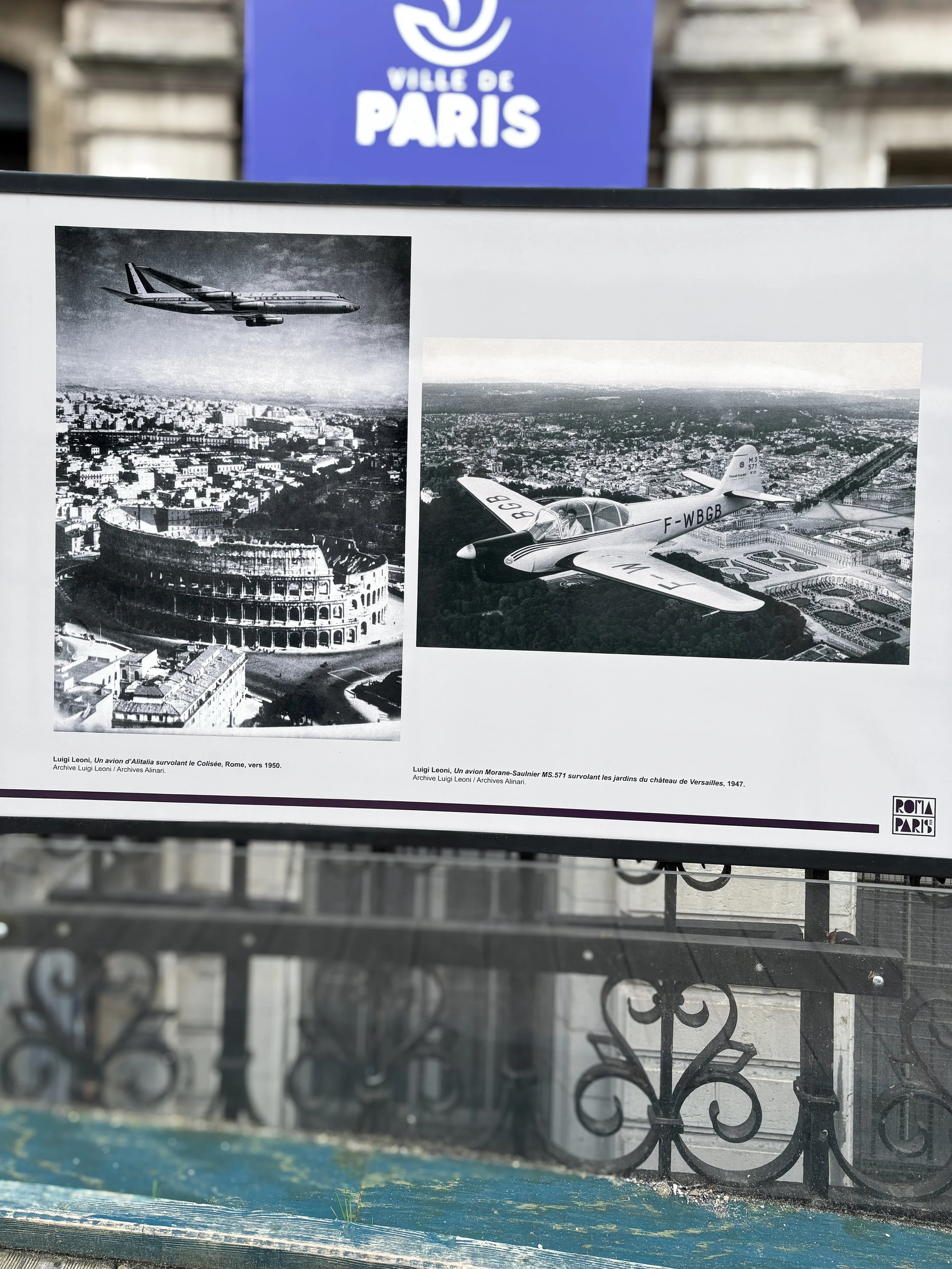
Roma/Paris - Avions
I found myself lingering in front of these large outdoor panels, fascinated by the diptych format. Seeing a 1950s aircraft over the Coliseum paired with its Versailles counterpart, or those kids of 1935 playing in both cities, is exactly the kind of visual dialogue that fuels my own Remix project which I will discuss with you at length in a few weeks.
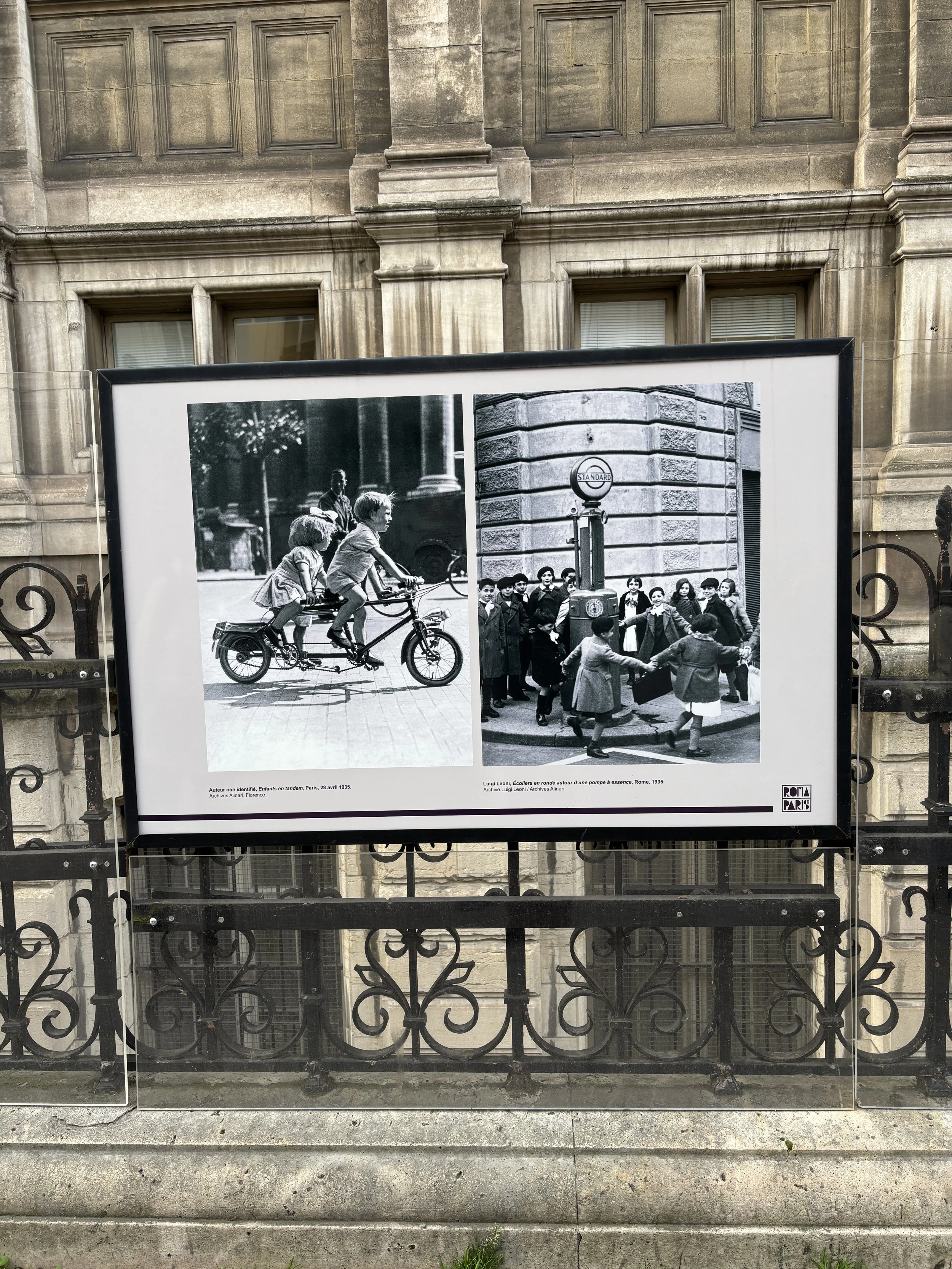
Roma/Paris - Children playing
These frames were designed for this specific urban natural light. Seeing them used elsewhere as mere digital "backdrops" for a different artist’s work felt like a missed opportunity to appreciate the city's own curation. For me, this was the perfect "visual appetizer": a moment of historical reflection before diving into the visceral world of Salgado.
A Haussmannian Cathedral
As I stepped through the doors, the gray stone of Paris vanished. I didn’t just enter a gallery; I entered a monument.
The architecture is pure Haussmannian grandeur: a cathedral-like space with towering ceilings and massive stone pillars. To manage over 120 photographs in such a volume, the curators made a bold choice: blood-red walls. This creates "rooms within a room », a psychological sanctuary that brings the viewer closer to the prints.
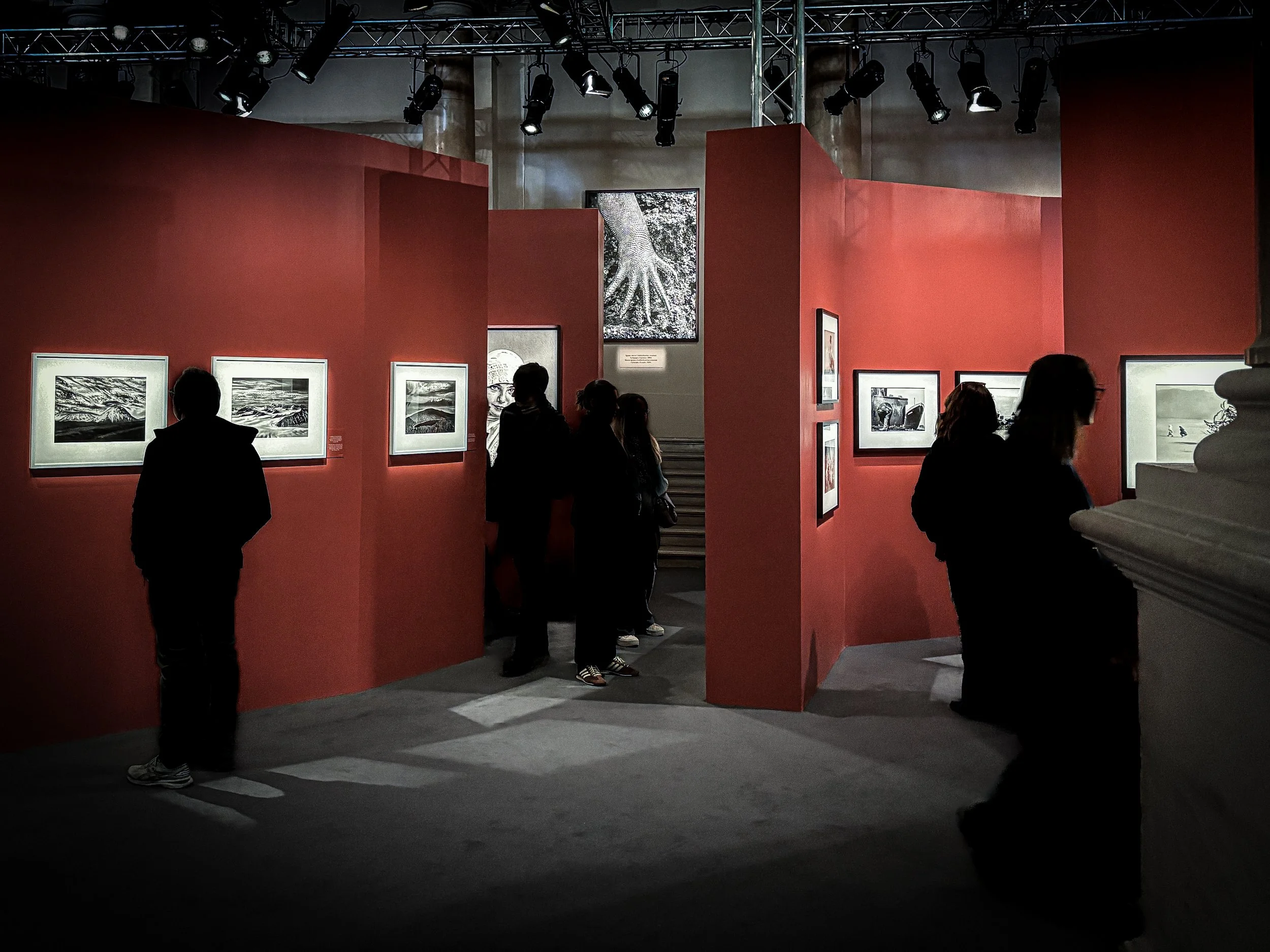
Exposition Sabastão Salgado, red walls
The Soul in the Silver: Poignant Humanity
But let’s be clear: every scenographic choice here is a servant to the image. And what images they are.
Salgado is the master of the silver-gelatin miracle. In this red-walled sanctuary, the power of his black and white photography hits you like a physical force. It is not just "monochrome"; it is a spectrum of light that seems to glow from within the paper.
• The Composition: Many of these photos have a classical, almost biblical composition. Whether it’s a vast landscape or a close-up of a paw, there is a geometric perfection that guides your eye toward the heart of the story.
• The Emotion: It is poignant. You don't just "see" the subjects; you feel their dignity, their struggle, and their profound humanity. Salgado has this unique gift of capturing the epic scale of the world without ever losing the individual's soul.
• The Beauty: There is a raw, sometimes painful beauty in these frames. It’s a reminder that photography can be a tool for truth and a work of high art simultaneously.
Choreographing the Gaze
The layout plays with your body to amplify this emotion:
• The Monumental Gaze: On the high walls, massive formats force you to lift your eyes. You feel the infinite scale of nature and the weight of history.
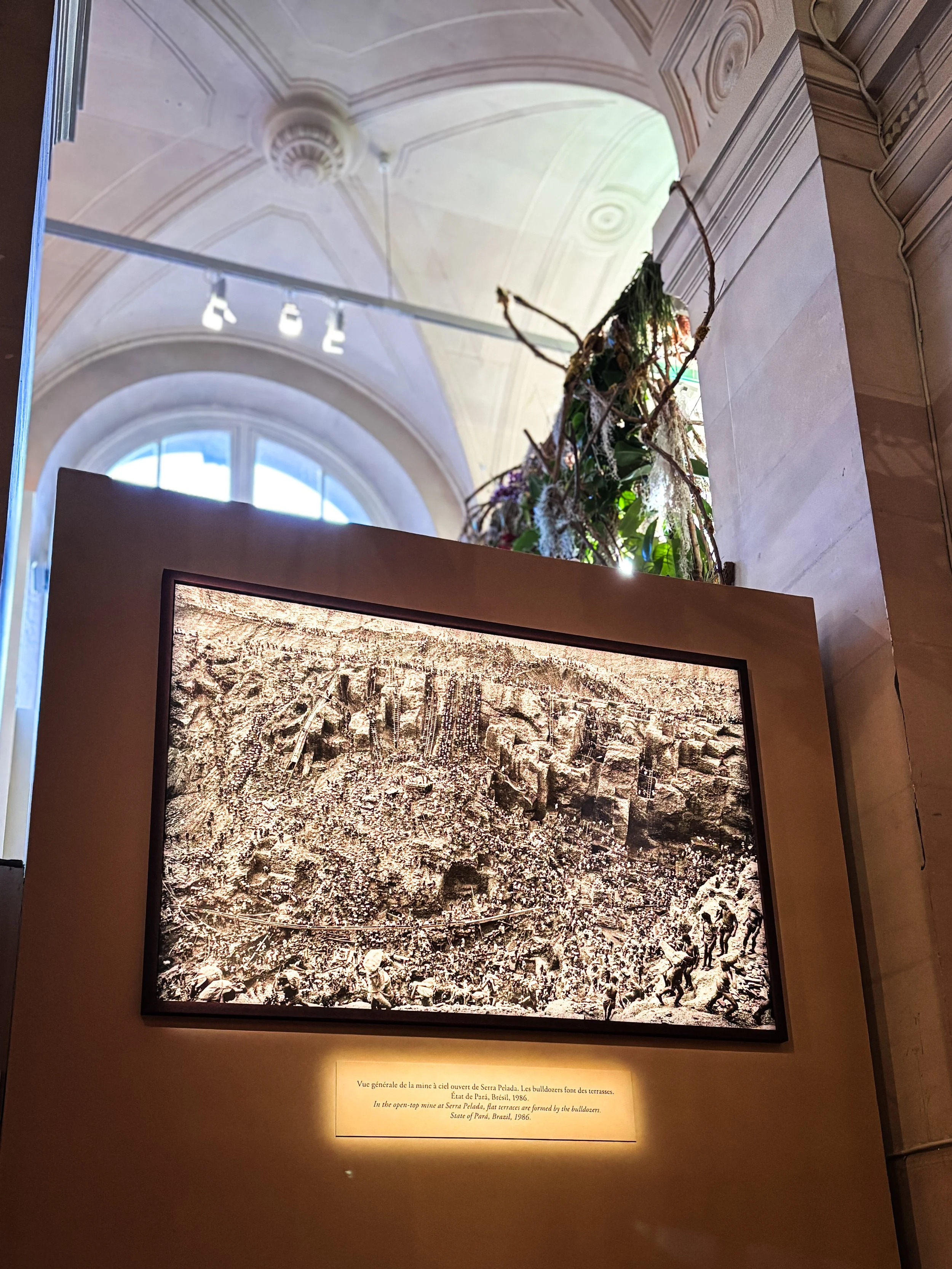
Cathedral walls
• The Intimate Path: In contrast, thematic "deambulations" at eye level break up the monumental hall. Here, you are invited to slow down and have a silent, one-on-one conversation with the human gaze captured in a portrait.
The Narrative Voice of the Frame
Even the framing serves the narrative:
• Integration: Large formats hung high without frames merge with the stone, as if the images were part of the building’s soul.
• Focus: Classic black frames with wide white passe-partouts create a "visual silence," forcing you to focus on the incredible texture of the prints.
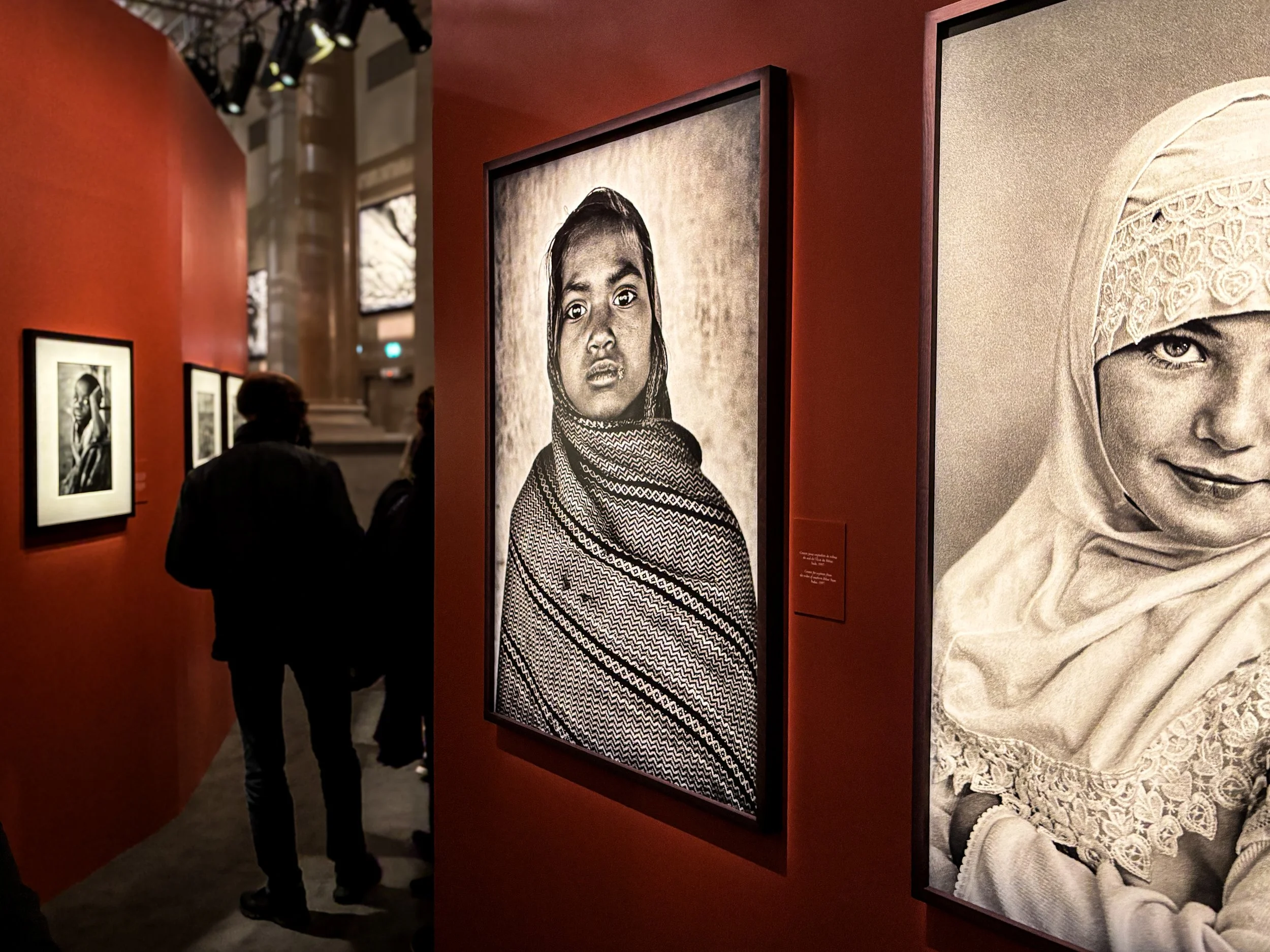
Portraits
• Proximity: Large portraits framed edge-to-edge in dark red wood remove all distance. The subject isn't "behind glass"; they are standing right there, sharing the room with you.
Conclusion: The Truth of the Paper
This visit was a confirmation. In this cathedral of stone and red, I had proof that photography cannot be reduced to a digital file. It is a physical object that needs space and real light to breathe.
This is precisely what I want to build with Grain de Bokeh. While digital mockups smooth out reality, I choose to celebrate the grain, the materiality, and the poignant humanity that only a real print in a real space can convey.
If you are in Paris before the end of May, go there. Experience the contrast. Feel the weight of these frames. Because in the end, photography isn't just seen with the eyes; it is felt with the whole body.
